Analog Guard® – Markets and Opportunity
A Mixed Signal, Physical-Layer Security Platform
Effective January 1, 2026, Signal Advance, Inc. transferred its Analog Guard® encryption technology and related intellectual property to Analog Guard, Inc. (“AGI”), a wholly owned subsidiary.
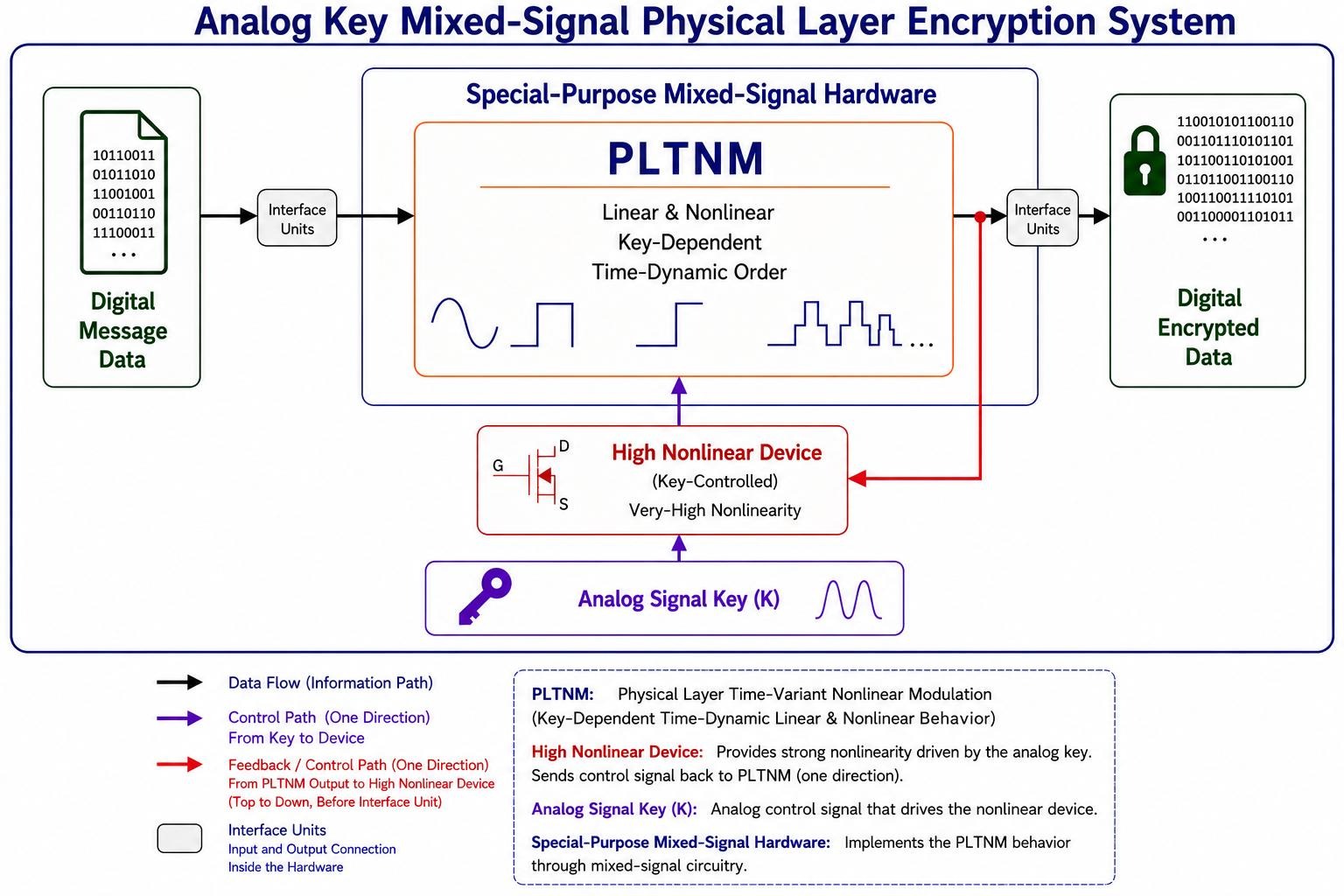
Analog Guard is being developed as a hardware-rooted encryption platform that protects information through a key-controlled transformation performed in mixed-signal (a mix of analog and digital circuitry) hardware at the physical signal layer, rather than exclusively in software. This is intended to diversify the attack surface and make remote software-based compromise more difficult, subject to continued prototype development, independent testing, and product-specific certification. A more detailed technical explanation of how Analog Guard works is available at analoguard.com.
The platform is intended to complement–not necessarily replace–established cybersecurity technologies. Analog Guard could be combined with conventional encryption, post-quantum cryptography, secure processors, hardware security modules, identity controls, and network-security systems to create an additional and technically distinct layer of protection.
Potential Applications
Analog Guard is being developed as a platform capable of supporting multiple form factors and security environments.
Enterprise Data Protection
Potential enterprise applications include protection of:
- Confidential corporate files and databases
- Financial, legal, healthcare, and customer records
- Research data and intellectual property
- Authentication records and security credentials
- Archived data and backup systems
- Proprietary algorithms, software, and source code
Analog Guard is intended to operate alongside existing file-, disk-, database-, and cloud-encryption systems as an additional layer of protection.
Data Storage and Endpoint Security
Potential storage and endpoint implementations include:
- Solid-state drives and storage controllers
- Servers and data-center equipment
- Desktop and notebook computers
- Secure removable-storage devices
- USB-A and USB-C security devices
- M.2 embedded security modules
- Network-attached and offline backup systems
Analog Guard is evaluating USB and M.2 product concepts, with schematics and PCB layouts in progress; production-ready commercial hardware is not yet available.
Embedded Systems, IoT and Industrial Equipment
Connected devices often have limited processing resources and restricted opportunities for software updates. Potential Analog Guard applications include:
- Industrial sensors and controllers
- Robotics and automated equipment
- Energy and utility infrastructure
- Connected vehicles and transportation systems
- Medical and laboratory equipment
- Remote-monitoring devices
- Smart-building and Internet of Things systems
Analog Guard is designed to be incorporated into an embedded device, communications module, controller, or system-on-chip architecture.
The broader IoT-security market was estimated at approximately $35.5 billion in 2024 and is projected by one research provider to reach approximately $141.8 billion by 2030. A separate analysis estimates the embedded-security market at approximately $10.1 billion in 2026, increasing to approximately $16.0 billion by 2031. [1][2]
Semiconductor and OEM Integration
Longer-term implementations may include Analog Guard circuitry integrated into:
- Mixed-signal integrated circuits
- Security processors and secure elements
- Storage and memory controllers
- Communications chipsets
- FPGA and ASIC platforms
- System-on-chip devices
- Hardware security appliances
Rather than manufacturing every end product directly, AGI may license its technology to semiconductor manufacturers, equipment suppliers, and OEMs–providing access to volume production without building fabrication or distribution operations internally.
Artificial Intelligence and Data Centers
Potential AI and data-center applications include protection of:
- Training and inference data
- Proprietary model weights
- Model-development environments
- Data transferred between accelerators, storage, and processors
- Edge-AI devices
- Proprietary prompts, outputs, and business information
Analog Guard is intended to supplement access controls, confidential-computing systems, and conventional encryption by adding protection at the physical signal and hardware-interface level.
Defense, Aerospace and Critical Infrastructure
Potential government and national-security applications include:
- Tactical and embedded communications
- Uncrewed and autonomous platforms
- Sensor and intelligence systems
- Secure storage and mission data
- Aerospace electronics
- Command-and-control equipment
- Critical-infrastructure monitoring and control
These markets place a high value on hardware-rooted security and operational independence, but require extensive testing, certification, and government procurement compliance.
No statement regarding defense applications should be interpreted as indicating that Analog Guard has been certified, approved, or adopted by any government agency or defense program.
Market Environment
Demand for cybersecurity, embedded security, secure key management, and data protection continues to expand. The FBI’s 2025 Internet Crime Report documented more than one million complaints and reported losses exceeding $20 billion, illustrating the continuing economic consequences of cyber-enabled crime. [3]
Current third-party market estimates include:
- A worldwide cybersecurity market valued at approximately $219 billion in 2025, projected to grow to approximately $699 billion by 2034. [4]
- A worldwide hardware-security-module market valued at approximately $1.8 billion in 2025, projected to reach approximately $5.0 billion by 2033. [5]
- A worldwide IoT-security market valued at approximately $35.5 billion in 2024, projected to reach approximately $141.8 billion by 2030. [1]
- A worldwide embedded-security market estimated at approximately $10.1 billion in 2026, projected to reach approximately $16.0 billion by 2031. [2]
These categories overlap and should not be added together; they describe market scale, not AGI’s addressable market or projected revenue.
The realizable opportunity will depend on technical validation, product development, manufacturing cost, certification, customer acceptance, licensing terms, competition, and the ability to demonstrate a meaningful security advantage.
Complementary Positioning
Analog Guard would enter a market already served by strong and widely adopted technologies, including:
- AES and other conventional symmetric encryption
- Public-key and post-quantum cryptography
- Hardware security modules
- Trusted platform modules and secure enclaves
- Self-encrypting drives
- Endpoint and network-security platforms
- Identity and access-management systems
- Key-management and data-loss-prevention products
NIST finalized its first three post-quantum cryptography standards in 2024. [6] Analog Guard is not a substitute for standardized post-quantum algorithms, but is intended to operate alongside them to provide defense in depth.
For example, a system could use:
- Established cryptography for standardized encryption, authentication, and key exchange;
- A hardware security module or secure element for key storage and management; and
- Analog Guard for an additional key-controlled transformation at the physical signal layer.
This layered architecture could force an attacker to overcome technically different security mechanisms rather than relying on a single form of protection.
Target Markets and Licensing Paths
AGI’s principal commercialization paths may include:
- Licensing semiconductor-ready circuit designs or IP blocks
- Licensing application-specific implementations to OEMs
- Joint development with cybersecurity and storage companies
- Integration into USB, M.2, embedded, and data-center products
- Government-funded development and defense contracting
- Technology evaluation agreements and paid pilot programs
- Strategic partnerships, minority investments, or joint ventures
- Acquisition by a semiconductor, defense, storage, or cybersecurity company
Near-term development is focused on a limited number of applications where Analog Guard can demonstrate measurable security, performance, and integration benefits.
Development and Intellectual-Property Position
Development to date includes issued and allowed patent rights, mixed-signal modeling and simulation, circuit design, and schematics, with PCB-layout work nearing completion.
However, Analog Guard has not yet reached volume production and does not currently have commercial product revenue. Its near-term value therefore rests primarily on its intellectual property, technical development, prototype potential, application breadth, and strategic licensing opportunity.
Continued development priorities include:
- Completion and fabrication of prototype circuit boards
- Bench testing against simulation results
- Independent cryptographic and engineering evaluation
- Comparison with conventional and emerging security technologies
- Development of USB, M.2, embedded, and integrated-circuit implementations
- Manufacturability, reliability, and environmental testing
- Product-specific certification and regulatory review
- Commercial licensing and strategic-partner engagement
IP Valuation
An August 2026 internal management-planning analysis estimated the current value of the Analog Guard intellectual-property portfolio at approximately $32 million, within an indicative range of $25 million to $40 million.
The estimate was weighted toward the issued and allowed core patent family and discounted for development-stage risk, including the absence of production hardware, completed third-party validation, established customers, and product revenue. Signal Advance has invested nearly $4.0 million in the technology and intellectual property now held by Analog Guard, Inc.
This is an internal management-planning estimate–not a certified appraisal, fairness opinion, or representation that the portfolio could be sold or licensed for the stated amount. It is not investment advice or a solicitation to buy or sell any security. The estimate reflects assumptions as of August 2026 and is subject to material change as development, testing, financing, market conditions, and commercialization activities progress.
Ownership Structure
Analog Guard, Inc. is a Texas corporation and, as of August 2026, is wholly owned by Signal Advance, Inc. Signal Advance therefore owns 100% of AGI’s outstanding equity, subject to any future financing, equity issuance, strategic transaction, or other change in capitalization.
Signal Advance shareholders have an indirect economic interest in Analog Guard through their ownership of Signal Advance shares; they do not directly own AGI shares or its intellectual property.
Additional information is available in the Company’s Investors section, including the current Executive Summary and Company disclosure reports.
Sources
For a technical description of how Analog Guard works, see our Analog Guard Technology page, or return to the Analog Guard overview.
For additional technical detail on the Analog Guard platform, visit the official Analog Guard website. You will leave the Signal Advance, Inc. website.